
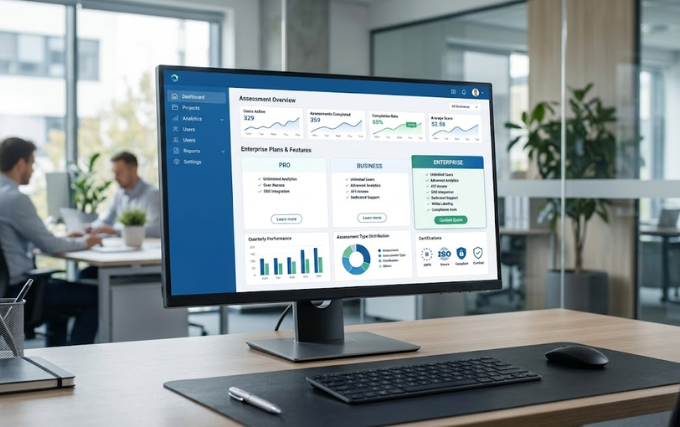
Organizations that manage online exams, professional certifications, employee assessments, or training programs often need more than a basic testing tool. They need reliable exam delivery, strong security, reporting, integrations, and enough capacity to handle large numbers of candidates. This makes test.com pricing enterprise plans an important topic for businesses that want to choose the right testing solution.
Test.com connects with Gauge Online, a platform focused on online testing, certification, training, and credential management. Gauge offers Professional and Enterprise options, with pricing that depends partly on exam volume and the features an organization needs. Enterprise customers can also receive volume-based pricing as their testing activity grows.
What Is Test.com?
Test.com, through its Gauge Online platform, focuses on organizations that need structured online assessments rather than simple quizzes. A business can use the platform for professional certification, employee testing, training assessments, compliance programs, and other formal examination needs.
For example, a certification organization may need to test thousands of candidates every year. A company may also need employees to complete training and pass assessments before they receive internal credentials. In these situations, the testing system needs to support much more than question creation.
Gauge brings testing, certification, reporting, integrations, and related tools into one platform. Therefore, larger organizations can use it as part of their wider assessment process.
Test.com Pricing Enterprise Plans Explained
When people search for test.com pricing enterprise plans, they often expect to find one simple annual price. However, enterprise pricing involves several components.
Current published information lists the Enterprise software starting price at $10,000 per year. Gauge also lists $1,000 per year for hosting and a $2,000 one-time setup fee. Based on these figures, the starting first-year cost comes to about $13,000.
Here is the basic calculation:
| Enterprise Cost | Starting Price |
| Software | $10,000/year |
| Hosting | $1,000/year |
| One-time setup | $2,000 |
| First-year starting total | $13,000 |
| Recurring software + hosting | $11,000/year |
These figures provide a starting point rather than a guaranteed final invoice. Large organizations can have different exam volumes, integration requirements, security needs, and implementation requirements. Consequently, businesses should request a detailed quote before making a final purchasing decision.
How Enterprise Volume Pricing Works
Exam volume plays an important role in the Enterprise model.
Gauge positions Enterprise for organizations that conduct more than 10,000 tests per year. The company also states that Enterprise volume pricing starts at around $3 per test and can decrease as testing volume increases. At very high volumes, Gauge says some customers can pay well below $1 per test.
This structure can make sense for organizations with thousands of candidates.
Consider two businesses. One company runs 10,500 tests annually, while another runs 100,000 tests. Their operational needs may differ significantly. A volume-based approach gives the provider room to calculate pricing according to the scale of the testing program.
However, buyers should not assume that multiplying the published per-test figure will produce their exact contract price. A sales quote can include different arrangements depending on volume and required services.
What Does the Enterprise Plan Offer?
Enterprise focuses on organizations that need advanced testing capabilities and higher operational capacity.
Important capabilities can include:
- Certification and digital badging
- Proctoring integrations
- Lessons and training content
- eCommerce capabilities
- Developer tools
- Platform integrations
- API and webhook functionality
- Reporting and analytics
- Security and access controls
- Support for large testing programs
These features can help organizations build a complete assessment process rather than relying on several unrelated systems.
For instance, a certification provider could create an assessment, deliver it to candidates, manage results, issue credentials, and connect the platform with other business systems.
Certification and Badging
Certification programs often need a reliable way to recognize successful candidates.
Enterprise capabilities can support certification and badging workflows, which can help organizations create a more structured credentialing experience. Instead of simply displaying a test score, an organization can connect successful assessment results with a formal credential.
This approach can benefit professional associations, training companies, certification bodies, and businesses that require employees to demonstrate specific skills.
Furthermore, digital credentials can make it easier for organizations to track achievements across a large candidate base.
Proctoring and Exam Security
Security becomes increasingly important as an assessment program grows.
A casual internal quiz may not require strict monitoring. However, professional certification exams can involve sensitive results and valuable credentials. Organizations therefore may need additional controls to protect exam integrity.
Enterprise capabilities include access to proctoring integrations, allowing businesses to connect assessment workflows with tools designed to monitor candidates during examinations.
This can help organizations create stronger testing procedures when candidate identity, exam integrity, and credential value matter.
Developer Tools and Integrations
Large organizations rarely operate with a single software platform. They often use learning management systems, customer databases, internal employee systems, payment platforms, and other business applications.
Developer tools and integrations can therefore become an important part of an Enterprise package.
API and webhook capabilities can help organizations connect testing activity with other systems. For example, a company could connect assessment results with an internal employee platform or trigger another business process after a candidate completes an exam.
This flexibility can reduce repetitive administrative work and make the testing platform more useful within an existing technology environment.
Professional vs. Enterprise Pricing
Gauge also offers a Professional option for organizations that do not need Enterprise-level scale.
Published starting figures show Professional at $750 per year, plus $250 annual hosting and a $500 one-time setup fee. That creates a starting first-year cost of approximately $1,500.
The comparison looks like this:
| Feature | Professional | Enterprise |
| Software starting price | $750/year | $10,000/year |
| Annual hosting | $250 | $1,000 |
| Setup fee | $500 | $2,000 |
| First-year starting cost | $1,500 | $13,000 |
| Large-volume testing | Limited compared with Enterprise | Yes |
| Certification features | Available | Available |
| Advanced integrations | Optional/add-on structure | Enterprise-focused |
| Volume pricing | Usage-based levels | Volume pricing available |
Professional can make more sense for a growing organization with moderate testing needs. Enterprise, on the other hand, targets organizations that conduct testing at a much larger scale.
What Factors Can Change the Final Enterprise Cost?
The starting price provides only part of the picture. Several factors can influence the final amount a business pays.
Number of Tests
Annual exam volume represents one of the biggest considerations. A program with thousands of tests has different economics from a program with tens or hundreds of thousands.
Required Features
Some organizations need only basic exam delivery. Others may require certification, proctoring, eCommerce, integrations, or advanced developer functionality.
Consequently, the final package should match actual business requirements.
Integrations
Companies that need connections with existing business software may require additional technical planning. API access, developer tools, and integration work can affect the overall project cost.
Setup and Implementation
Enterprise deployments can require more preparation than small testing projects. Teams may need to configure assessments, users, workflows, integrations, and administrative processes.
Hosting
Enterprise pricing also includes a separate annual hosting component. The published starting figure currently lists $1,000 per year for Enterprise hosting.
Benefits of Choosing an Enterprise Plan
The biggest advantage comes from scale.
An organization that runs thousands of assessments needs a platform that can support its operational requirements without forcing employees to manage everything manually.
Enterprise can provide several practical benefits.
Better scalability: Large testing programs can handle higher exam volumes without relying on a basic testing setup.
Broader functionality: Certification, proctoring integrations, lessons, eCommerce, and developer tools can support more complex programs.
Greater integration potential: APIs, webhooks, and developer tools can help connect assessment workflows with existing systems.
Improved administration: A centralized testing platform can reduce the need to manage multiple disconnected tools.
Better long-term planning: Volume-based pricing can become more attractive as an organization’s testing activity increases.
Who Should Consider Test.com Enterprise?
Enterprise makes the most sense for organizations where testing plays an important operational role.
Potential users include:
- Professional certification organizations
- Training companies
- Industry associations
- Large employers
- Government-related programs
- Educational organizations
- Compliance training providers
- Businesses with large employee assessment programs
A small company that conducts a few hundred simple quizzes each year may not need this level of functionality. In contrast, an organization that manages thousands of formal assessments can benefit more from enterprise-level capabilities.
Is Test.com Enterprise Worth the Cost?
The answer depends on how heavily an organization relies on testing.
A first-year starting cost of approximately $13,000 represents a significant investment for a small company. However, the calculation changes when an organization conducts more than 10,000 tests annually and needs certification, integrations, security, reporting, or other advanced capabilities.
For example, a large certification body may gain considerably more value from an integrated assessment platform than from several inexpensive tools that require manual coordination.
Therefore, businesses should evaluate the total operational value rather than looking only at the subscription price.
What Should You Ask Before Buying?
Before signing an Enterprise agreement, organizations should request clear answers to several questions:
- What will the final annual price look like for the expected test volume?
- Does the quote include hosting?
- What does the setup fee cover?
- Which integrations come with the selected package?
- How does volume pricing change as exam numbers increase?
- What proctoring options can the platform support?
- Which certification and badging tools are included?
- What support does the Enterprise customer receive?
- Are API and webhook capabilities included?
- Are there additional charges for services or technical work?
These questions can help a buyer understand the complete financial commitment instead of relying only on the headline price.
Conclusion
Test.com pricing enterprise plans revolve around more than a single subscription number. The current Enterprise starting point stands at $10,000 per year for software, with $1,000 annual hosting and a $2,000 one-time setup charge. That creates an approximate first-year starting cost of $13,000 before other requirements or negotiated arrangements.
The platform can become particularly valuable for organizations that manage more than 10,000 tests annually. Volume pricing, certification tools, proctoring integrations, developer capabilities, and other enterprise features can support complex assessment programs.
Ultimately, the right choice depends on testing volume, required features, integrations, and the value that a centralized assessment system can provide. Businesses should compare their actual requirements with a detailed Enterprise quote before committing to a long-term plan.
