
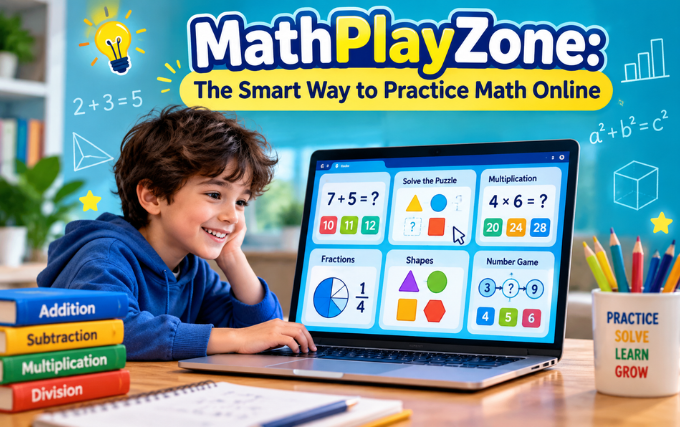
Mathematics plays an important role in everyday life. From managing money to solving complex problems, people use math in countless situations. However, many students struggle with numbers, formulas, and calculations. Traditional learning methods sometimes make the subject feel difficult or boring. Fortunately, online learning offers a more enjoyable approach.
MathPlayZone introduces a fun way to explore mathematical concepts through interactive activities, games, and regular practice. Instead of relying only on textbooks, learners can explore different problem-solving methods and develop stronger mathematical skills.
Moreover, digital learning allows students to practice at their own pace. Whether someone wants to improve basic arithmetic or tackle challenging equations, online math activities can make learning more engaging.
What Is MathPlayZone?
MathPlayZone represents an interactive approach to learning mathematics through online practice and educational games. The concept combines mathematical exercises with enjoyable activities that encourage students to think, calculate, and solve problems.
Unlike traditional classroom exercises, interactive math learning creates opportunities for active participation. Students can explore numbers, recognize patterns, and improve their understanding through practical challenges.
Furthermore, game-based learning can reduce the pressure that students sometimes experience during math lessons. Colorful activities, simple instructions, and interesting challenges help learners stay focused.
Children often enjoy solving puzzles more than completing repetitive worksheets. Therefore, combining entertainment with educational exercises can encourage consistent practice.
Parents and teachers can also use this learning approach to support classroom lessons and independent study.
Why Online Math Practice Matters
Technology has changed how students access educational resources. Today, learners can explore mathematical concepts without depending entirely on classroom instruction.
Online practice provides flexibility and encourages students to develop independent learning habits. Additionally, interactive exercises allow learners to revisit difficult topics whenever they need extra practice.
Learning at Your Own Pace
Every student learns differently. Some children understand multiplication quickly, while others need additional time to master the same concept.
Online activities allow learners to spend more time on challenging subjects without feeling rushed. As a result, students can gradually build confidence and improve their understanding.
Making Mathematics More Enjoyable
Many students associate mathematics with difficult examinations and complicated calculations. However, interactive games can change this perception.
Educational puzzles, number challenges, and problem-solving activities introduce excitement into the learning process. Consequently, students may feel more motivated to practice regularly.
Encouraging Independent Thinking
Mathematics requires more than memorizing formulas. Students must understand problems, recognize relationships, and choose appropriate solutions.
Interactive activities encourage learners to explore different approaches. Over time, this practice can strengthen logical thinking and decision-making abilities.
Important Math Skills Students Can Practice
MathPlayZone-style learning activities can support several essential mathematical skills. Each subject contributes to a stronger understanding of numbers and problem-solving techniques.
1. Addition and Subtraction
Addition and subtraction form the foundation of mathematical learning. Children usually encounter these concepts during their earliest school years.
Simple number games help students understand how quantities increase or decrease. For example, a learner might calculate the total number of apples in two baskets or determine how many objects remain after removing several.
Furthermore, regular practice improves calculation speed and numerical confidence.
2. Multiplication and Division
Multiplication and division introduce students to more advanced numerical relationships.
Through interactive challenges, learners can practice multiplication tables, identify number patterns, and understand equal sharing.
For instance, dividing 24 candies among six children helps explain division through a familiar situation.
Similarly, multiplication games encourage students to recognize repeated addition rather than memorize answers without understanding them.
3. Fractions and Decimals
Fractions and decimals often create confusion because they introduce different ways to represent numbers.
Visual exercises can make these concepts easier to understand. Students might divide a pizza into equal pieces or compare decimal values through number-based activities.
Additionally, practical examples help learners connect mathematical ideas with everyday experiences.
4. Geometry and Shapes
Geometry introduces important concepts such as shapes, angles, measurements, and spatial relationships.
Interactive exercises can encourage students to identify triangles, rectangles, circles, and other geometric figures.
Meanwhile, shape-matching games help younger learners recognize visual patterns.
Older students can explore perimeter, area, and basic geometric calculations through more challenging activities.
5. Problem-Solving and Logical Reasoning
Problem-solving plays a central role in mathematics. Students must analyze information before selecting the correct method.
Puzzles and logical challenges encourage careful thinking. Moreover, these activities help learners develop patience when they encounter difficult questions.
With consistent practice, students can become more comfortable approaching unfamiliar mathematical problems.
How MathPlayZone Makes Learning More Engaging
Traditional learning often involves reading explanations and completing written exercises. Although these methods remain useful, interactive activities can provide additional motivation.
MathPlayZone focuses on the idea that students learn effectively when they actively participate in educational tasks.
Interactive Learning Activities
Interactive math activities encourage students to engage directly with mathematical problems.
Instead of simply reading an explanation, learners can solve questions, explore patterns, and test their understanding.
This active approach helps students recognize mistakes and develop stronger problem-solving habits.
Game-Based Challenges
Educational games introduce an enjoyable element into mathematical practice.
Students might complete number puzzles, solve timed challenges, or work through different difficulty levels.
Furthermore, small achievements can encourage learners to continue practicing.
The goal involves improving understanding while maintaining interest in the subject.
Regular Practice Opportunities
Mathematical skills improve through repetition and understanding. However, repeating identical exercises can become boring.
Different types of activities provide variety while reinforcing essential concepts.
Consequently, learners can strengthen their knowledge without depending on a single practice method.
Benefits of MathPlayZone for Students
Interactive mathematical learning offers several advantages for students of different ages.
Improved confidence: Regular practice helps students become more familiar with mathematical questions. As learners understand concepts, they may approach challenging problems with greater confidence.
Stronger concentration: Educational games require attention and careful thinking. Therefore, students can practice staying focused while completing specific tasks.
Better calculation skills: Frequent arithmetic exercises encourage accuracy and faster mental calculations. Additionally, repeated exposure to numerical patterns can improve mathematical fluency.
Greater learning motivation: Interesting challenges can make mathematics feel less intimidating. When students enjoy an activity, they often show greater willingness to continue learning.
Development of logical thinking: Puzzles encourage learners to examine information, compare possibilities, and reach reasonable conclusions.
Together, these benefits can support academic progress and everyday problem-solving abilities.
How Parents Can Support Math Learning at Home
Parents play an important role in helping children develop positive learning habits.
Although online activities provide valuable practice opportunities, parental encouragement can make the experience more meaningful.
First, parents should establish a comfortable learning environment. A quiet space allows children to concentrate without unnecessary distractions.
Next, setting realistic practice goals helps students maintain consistency. For younger children, short sessions may work better than lengthy exercises.
Furthermore, parents can connect mathematics with daily activities. Shopping, cooking, and measuring objects provide simple opportunities to practice numerical skills.
For example, asking children to calculate the cost of several items can improve their understanding of addition and multiplication.
Most importantly, parents should encourage effort rather than focus entirely on correct answers. Mistakes create opportunities to learn and improve.
How Teachers Can Use Interactive Math Activities
Teachers can combine digital exercises with traditional classroom instruction to create a more balanced learning experience.
For instance, an educator might explain multiplication before introducing a related number game. Students can then apply their understanding through practical exercises.
Additionally, interactive challenges can provide variety during classroom lessons.
Teachers may also organize small group activities that encourage teamwork and mathematical discussion.
However, digital exercises should complement clear explanations, written practice, and individual guidance.
A balanced approach helps students understand mathematical concepts rather than simply guess answers during games.
MathPlayZone for Different Age Groups
Students need different learning experiences depending on their age and mathematical understanding.
Young Children
Younger learners benefit from simple counting activities, number recognition, and basic shape identification.
Colorful puzzles and easy arithmetic questions can introduce mathematical ideas without overwhelming children.
Moreover, familiar objects such as fruits, toys, and animals make numerical examples easier to understand.
Primary School Students
Primary school learners usually focus on addition, subtraction, multiplication, division, and introductory fractions.
Interactive practice can reinforce classroom lessons while helping students improve calculation accuracy.
Meanwhile, word problems encourage children to connect mathematics with real-life situations.
Middle School Students
Middle school mathematics introduces more advanced topics, including decimals, percentages, ratios, and basic algebra.
Students can use online exercises to strengthen their understanding of these concepts.
Furthermore, logical challenges encourage independent thinking and prepare learners for increasingly complex mathematical tasks.
Older Students
Older learners often study algebra, geometry, equations, and other advanced mathematical subjects.
Targeted practice can help them identify areas that require additional attention.
Nevertheless, students should choose activities that match their curriculum and current ability level.
Tips for Getting Better Results From Online Math Practice
Successful mathematical learning requires consistency, patience, and an effective study routine.
Students can improve their experience by following several practical strategies.
- Start with familiar topics. Review basic concepts before moving toward more complicated problems.
- Practice regularly. Spend a manageable amount of time solving mathematical exercises each day.
- Understand mistakes. Examine incorrect answers and identify the steps that caused confusion.
- Increase difficulty gradually. Move toward harder challenges after developing confidence with simpler exercises.
- Apply math in daily life. Use shopping, cooking, and measurement activities to reinforce classroom knowledge.
- Balance games with written work. Combine interactive exercises with traditional problem-solving practice.
Above all, learners should focus on understanding concepts instead of rushing through activities.
Consistent effort usually produces better long-term results than occasional intensive practice.
Common Challenges in Online Math Learning
Despite its advantages, online learning also presents certain challenges.
Some students become distracted by unrelated websites, games, or notifications. Therefore, creating a focused learning environment remains important.
Others may concentrate too heavily on earning points or completing challenges quickly. Unfortunately, this approach can reduce attention to mathematical understanding.
Parents and teachers should encourage students to explain how they reach their answers.
Additionally, excessive screen time may affect concentration and comfort. Regular breaks can help learners maintain a healthier study routine.
Another challenge involves choosing exercises that match individual abilities. Activities that seem too easy may create boredom, while extremely difficult questions can cause frustration.
For this reason, learners should select appropriate difficulty levels and progress gradually.
The Future of Interactive Math Education
Digital technology continues to create new opportunities for mathematical learning.
Interactive simulations, educational games, and personalized exercises can help students explore mathematical concepts in different ways.
Furthermore, adaptive learning technology can adjust question difficulty according to a student’s performance. This approach may help learners focus on subjects that require additional attention.
Artificial intelligence also offers possibilities for explaining mathematical steps and providing individualized guidance.
However, technology alone cannot replace curiosity, consistent practice, or effective teaching.
Students still need clear explanations, meaningful exercises, and opportunities to apply mathematical knowledge.
As educational tools continue to develop, interactive learning may become an increasingly important part of mathematics education.
Conclusion
Mathematics becomes easier to understand when students receive clear explanations, regular practice, and opportunities to explore different problem-solving methods.
MathPlayZone highlights an engaging approach to mathematical learning by bringing together educational activities, interactive challenges, and essential numerical concepts.
From basic arithmetic to advanced problem-solving, learners can strengthen their abilities through consistent practice and thoughtful participation.
Moreover, parents and teachers can support this process by encouraging curiosity, celebrating progress, and connecting mathematical ideas with everyday situations.
Ultimately, successful math learning requires patience, understanding, and steady effort. With the right approach, students can develop stronger mathematical skills, greater confidence, and a more positive attitude toward numbers.
