
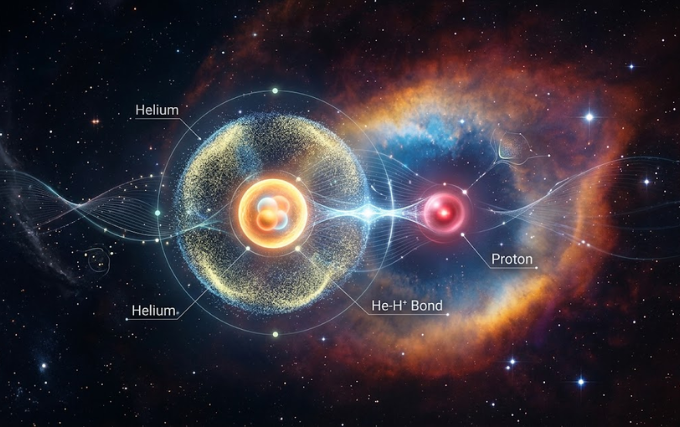
When you first hear the word helonium, it may sound like the name of an element from the periodic table. However, helonium does not represent a separate chemical element. In chemistry, the term refers to the helium hydride ion, written as HeH⁺. This unusual molecular ion combines helium and hydrogen and carries a single positive charge.
Helonium has attracted attention because it connects several areas of science, including chemistry, molecular physics, spectroscopy, and astronomy. Its simple structure also gives researchers an interesting way to study how atoms interact under unusual conditions.
So, what exactly does helonium mean, how does it form, and why does it matter? Let’s explore its main characteristics in simple terms.
What Is Helonium?
Helonium refers to the helium hydride ion, HeH⁺. The formula contains two important symbols. “He” represents helium, while “H” represents hydrogen. The plus sign shows that the entire species carries one positive electrical charge.
Unlike helium gas, helonium does not exist as a simple collection of neutral helium atoms. Instead, it describes a molecular ion involving helium and hydrogen.
Chemists classify HeH⁺ as a heteronuclear diatomic molecular ion. “Diatomic” means that it contains two atomic nuclei, while “heteronuclear” means that those nuclei come from different elements.
That distinction makes helonium easier to understand. It does not belong on the periodic table as a new element. Instead, it represents a particular chemical species involving two familiar elements.
Helonium vs. Helium
The similarity between the two names can create confusion. Helium and helonium have very different meanings.
Helium represents a chemical element with the symbol He and atomic number 2. It belongs to the noble gas group and normally shows very low chemical reactivity.
Helonium, in contrast, refers to HeH⁺. It contains helium and hydrogen and carries a positive charge.
A simple comparison looks like this:
| Term | Meaning | Formula |
| Helium | Chemical element | He |
| Hydrogen | Chemical element | H |
| Helonium | Helium hydride ion | HeH⁺ |
| Helium hydride ion | Molecular ion | HeH⁺ |
Therefore, you should not use “helium” and “helonium” as interchangeable terms.
What Does HeH⁺ Mean?
The formula HeH⁺ provides a quick description of the ion.
The helium component contributes a helium nucleus, while the hydrogen component contributes a hydrogen nucleus. The entire species carries a positive charge.
Scientists often describe HeH⁺ as protonated helium because a proton can interact with neutral helium and produce the ion under suitable conditions.
A simplified representation looks like this:
He + H⁺ → HeH⁺
Real chemical and astrophysical environments involve more complicated reaction pathways, so this equation only provides a basic picture. Still, it helps explain why the ion contains helium, hydrogen, and a positive charge.
Why Does Helonium Matter?
At first glance, a tiny ion containing only two elements may seem insignificant. However, its simplicity gives scientists an excellent subject for fundamental research.
Helium normally resists chemical bonding because its electrons occupy a stable configuration. Yet certain energetic environments allow helium to interact with a proton and form HeH⁺.
That unusual behavior gives researchers an opportunity to examine chemical bonding, molecular structure, ion reactions, and spectroscopy.
Furthermore, scientists connect HeH⁺ with the chemistry of the early universe. Research has described the ion as a candidate for one of the earliest molecular species that could form after the universe began cooling enough for chemistry to develop.
This connection gives helonium importance beyond ordinary laboratory chemistry.
The Early History of Helonium Research
Scientists have studied helium hydride ions for many decades. Early experimental work identified evidence for HeH⁺ during laboratory experiments in the 1920s. Researchers could investigate the ion under controlled conditions even though astronomers still struggled to identify it in space.
The difficulty came from the ion’s unusual nature. Astronomers needed to identify a specific spectral signature among many signals from hot and complex astronomical environments.
For years, researchers expected to find HeH⁺ in suitable regions of space, but observations did not provide an unquestionable detection.
That situation eventually changed.
Helonium in Space
One of the most important developments in the story of HeH⁺ came in 2019, when researchers reported its astronomical detection in the planetary nebula NGC 7027.
Scientists used NASA’s SOFIA airborne observatory to identify the characteristic spectral signal associated with HeH⁺. The observation gave researchers direct evidence that the ion exists in an astronomical environment rather than only in laboratory experiments.
This discovery matters because NGC 7027 provides a natural environment where energetic radiation and ionized gas can support unusual chemistry.
The observation also strengthened scientific interest in HeH⁺ as a link between laboratory molecular physics and astronomical chemistry.
What Makes Helonium Unusual?
Several features make helonium particularly interesting.
1. It Contains Helium
Helium normally shows very little chemical activity. Its stable electron arrangement makes ordinary chemical bonding difficult.
However, HeH⁺ demonstrates that helium can participate in a molecular ion under suitable conditions.
2. It Carries a Positive Charge
The plus sign in HeH⁺ matters. Helonium does not behave like a neutral molecule because it carries an overall positive electrical charge.
This charge influences its interactions with other particles and affects how scientists detect it through spectroscopy.
3. It Has a Very Simple Structure
HeH⁺ contains only two atomic nuclei. That simplicity makes it useful for theoretical calculations and fundamental studies of molecular physics.
Researchers can compare detailed calculations with experimental and astronomical observations without dealing with the enormous complexity found in larger molecules.
4. It Connects Chemistry and Astronomy
Helonium appears in discussions about molecular chemistry, ionized gases, spectroscopy, and cosmic evolution.
Few chemical species provide such a direct connection between basic molecular behavior and the history of chemistry in the universe.
How Does Helonium Form?
HeH⁺ can form when helium interacts with a hydrogen ion under suitable energetic conditions. A proton can approach a helium atom and create the helium hydride molecular ion.
Scientists study several formation and destruction pathways because the ion can also react with other particles or break apart.
In space, conditions such as intense radiation, hot gas, and ionization can influence the balance between HeH⁺ formation and destruction.
Therefore, scientists do not treat helonium as a substance that simply forms everywhere helium and hydrogen meet. The surrounding environment plays a major role.
Where Can Scientists Study Helonium?
Researchers can investigate HeH⁺ in both laboratory and astronomical settings.
Laboratories allow scientists to create controlled environments and measure molecular properties. These experiments help researchers test theoretical models and understand how helium hydride ions behave.
Astronomical observations provide a different perspective. Instead of creating the ion directly, scientists search for its characteristic radiation or spectral signature in space.
Together, these approaches provide a more complete picture.
Laboratory research helps explain the underlying physics, while astronomical observations show how the ion behaves in natural cosmic environments.
Helonium and Spectroscopy
Spectroscopy plays an important role in studying HeH⁺.
Every molecule or molecular ion interacts with electromagnetic radiation in particular ways. Scientists can examine those interactions to identify chemical species in distant environments.
For astronomical research, this technique becomes especially valuable because scientists cannot collect a sample from a distant planetary nebula and bring it into a laboratory.
Instead, researchers analyze light and other electromagnetic signals.
The successful identification of HeH⁺ in NGC 7027 demonstrated how advanced astronomical instruments can reveal extremely simple molecules and ions across enormous distances.
Does Helonium Have Everyday Uses?
Helonium does not have major household or everyday applications.
You may encounter helium in balloons, cooling systems, scientific equipment, and other practical applications. Helonium has a very different role.
Researchers mainly study it for scientific purposes. Its value comes from what it can teach us about molecular physics, ion chemistry, spectroscopy, and astronomical environments.
Consequently, you should not think of helonium as a commercial gas or a common industrial material.
Is Helonium a New Element?
No. This remains one of the most important points to remember.
Helonium does not have its own atomic number, and you will not find it as a separate element on the periodic table.
Instead:
Helium = element
Hydrogen = element
Helonium = HeH⁺ molecular ion
The unusual name can make the term sound like an undiscovered element, but the scientific definition clearly places it in a different category.
Why the Name “Helonium”?
The word helonium combines “helium” with the chemical ending “-onium.” Wiktionary lists helonium as an inorganic chemistry term and gives helium hydride as its synonym.
The ending can make the word resemble other names for positively charged chemical species. However, the name itself does not make helonium an element.
For readers who encounter the term for the first time, remembering the formula HeH⁺ provides the clearest shortcut to its meaning.
Helonium vs. Helionium
Another term can cause confusion: helionium.
Although the names look almost identical, helonium and helionium do not refer to the same scientific concept. Helonium refers to the helium hydride ion, HeH⁺. Therefore, anyone researching the term should check the spelling carefully.
This small difference can lead to completely different search results and scientific discussions.
FAQs
Q: What is helonium?
A: Helonium refers to the helium hydride ion, HeH⁺. It contains helium and hydrogen and carries a single positive charge.
Q: Is helonium an element?
A: No. Helonium does not represent a chemical element. It represents a molecular ion.
Q: What is the formula for helonium?
A: The formula is HeH⁺.
Q: Is helonium the same as helium?
A: No. Helium represents the element He, while helonium refers to the helium hydride ion HeH⁺.
Q: Why does helonium interest scientists?
A: Researchers study it because its unusual chemistry provides insights into molecular physics, ion chemistry, spectroscopy, and astronomical environments.
Q: Did scientists detect helonium in space?
A: Yes. Researchers reported the astronomical detection of HeH⁺ in the planetary nebula NGC 7027 in 2019.
Q: Does helonium have common household uses?
A: No significant everyday applications exist. Scientists mainly investigate it for fundamental chemical and astronomical research.
Conclusion
Helonium may sound mysterious, but its scientific identity remains quite specific. Helonium refers to the helium hydride ion, HeH⁺, a positively charged molecular ion involving helium and hydrogen.
Its unusual chemistry makes it valuable for fundamental research. More importantly, its connection with astronomical observations gives scientists another way to investigate how simple chemical species behave in space.
The 2019 detection of HeH⁺ in NGC 7027 added an important piece to the long history of helium hydride research.
Ultimately, the easiest way to remember helonium is simple: helium is an element, while helonium is HeH⁺. That distinction clears up most confusion surrounding the term and explains why this tiny molecular ion continues to interest chemists, physicists, and astronomers.
