
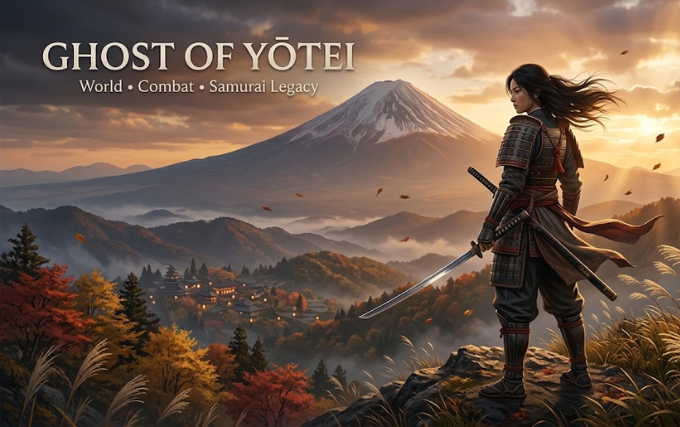
Ghost of Yōtei takes players into a new chapter of Sucker Punch Productions’ samurai-inspired action series. The adventure moves away from Jin Sakai and Tsushima and introduces a completely new warrior, Atsu. Set in northern Japan during the 1600s, the game combines revenge, exploration, swordplay, stealth, and personal healing.
Unlike a direct continuation of Jin’s story, the game presents a standalone experience. However, it keeps the atmosphere, cinematic presentation, and freedom that made Ghost of Tsushima so popular. Sucker Punch also designed the adventure around a new interpretation of the “Ghost” legend.
A New Hero Named Atsu
Atsu stands at the center of the adventure. Sixteen years before the main events, the Yōtei Six attacked her family and left her for dead. The attack changed her life and pushed her toward years of training.
After spending years fighting across Japan, Atsu returns to Ezo with one purpose. She wants to hunt the six outlaws responsible for destroying her family.
Her list includes The Snake, The Oni, The Kitsune, The Spider, The Dragon, and Lord Saito. Each target presents a different challenge, which gives the story a strong sense of progression.
However, revenge does not define Atsu forever. As she travels across Ezo, she meets unexpected allies and develops relationships that change her outlook. Consequently, the story explores healing and redemption alongside anger and revenge.
The Wild World of Ezo
The game moves the action to Ezo, a historical region that corresponds broadly with modern-day Hokkaido. Mount Yōtei provides one of the adventure’s most recognizable landmarks.
Players can explore forests, fields, settlements, mountains, and snowy landscapes. The environment creates a strong contrast between peaceful natural beauty and dangerous encounters.
Moreover, exploration does not force players into one strict route. You can choose which Yōtei Six member to pursue and decide how you want to approach different objectives.
Atsu can travel on foot or horseback while searching for targets, bounties, activities, and training opportunities. The open-world structure therefore encourages curiosity instead of simply pushing players from one mission to another.
Freedom Shapes the Adventure
One of the game’s strongest ideas involves player freedom. Instead of following a single predetermined hunting order, players can decide which target deserves attention first.
You can also pursue additional bounties and search for weapon masters. These activities help Atsu expand her abilities while giving exploration a meaningful purpose.
Campfires add another personal element to the journey. Atsu can establish camp in the open world, rest, prepare for the road, and interact with allies. Travelers can also provide information, exchange items, share meals, and reveal clues about future targets.
This approach makes the world feel less like a collection of missions and more like a place where Atsu actually travels.
A Deeper Samurai-Inspired Combat System
Combat remains one of the most important parts of the experience. Atsu can fight with swords while also using ranged weapons and specialized tools.
The game encourages players to train with different masters and learn new equipment. As a result, players can develop a fighting style that matches their preferred approach.
Close-range combat rewards timing, positioning, and careful attacks. At other moments, ranged weapons and stealth tools provide safer alternatives.
The variety also helps encounters feel less repetitive. Instead of relying on one weapon throughout the entire adventure, Atsu can expand her arsenal and adapt to different threats.
Stealth and the Ghost Identity
The Ghost concept remains central to the series, but Ghost of Yōtei gives it a new meaning through Atsu.
She can use stealth techniques and specialized Ghost tools when direct combat creates too much danger. Smoke, blinding powder, bombs, and other tools can help her control encounters.
For example, the game’s broader combat design allows Atsu to combine swordplay with stealth and ranged attacks. This flexibility lets players decide whether they want to confront enemies openly or strike from unexpected positions.
Therefore, the Ghost identity does not simply represent a costume or fighting technique. It also represents the legend Atsu creates through her actions.
Weapons Create Different Playstyles
Atsu’s combat options extend beyond a traditional katana. Players can unlock and develop different weapons as they progress.
The weapon variety supports different approaches to combat. A player who enjoys direct sword fights can focus on close-range mastery. Meanwhile, another player might prefer stealth, ranged attacks, or combinations of several tools.
This system strengthens the game’s role-playing elements without turning the adventure into a traditional statistics-heavy RPG.
Furthermore, weapon training gives exploration another purpose. Searching for masters and learning new techniques can directly influence how Atsu handles future battles.
Japanese Culture Beyond Combat
Ghost of Yōtei does more than present sword fights and revenge missions. The world includes activities that highlight everyday cultural experiences.
Players can visit shrines, relax in onsens, practice Sumi-e painting, prepare food, and interact with travelers. These quieter moments give the adventure room to breathe.
Campfires also create opportunities for reflection and conversation. Instead of moving constantly from one battle to another, Atsu can pause and connect with people around her.
That contrast strengthens the storytelling. Violent encounters feel more intense when the player can later return to peaceful landscapes and personal moments.
The Samurai Legacy
Although Ghost of Yōtei introduces a new protagonist, it continues the broader legacy of samurai storytelling established by Ghost of Tsushima.
The game focuses on warriors, honor, revenge, survival, loyalty, and personal transformation. Yet Atsu does not simply repeat Jin Sakai’s journey.
Sucker Punch deliberately created a new hero, a new setting, and a different interpretation of the Ghost idea. The developers wanted players to experience another origin story rather than simply extend Jin’s narrative.
That decision gives the game its own identity while preserving familiar themes.
The connection becomes even more interesting through optional references and returning concepts. The game can therefore honor the previous adventure without depending on it.
A World Designed for Atmosphere
Visual presentation plays a major role in the experience. Sucker Punch focused heavily on movement, weather, clothing, foliage, particles, and environmental details.
Wind affects clothing, weapon decorations, and hanging materials around settlements. Combat can also produce visible dust, leaves, mud, and blood.
These details make movement and combat feel connected to the environment rather than isolated from it.
The result creates a world where natural beauty and violence constantly exist side by side.
Snow-covered mountains can stand behind a tense battle. A quiet meadow can provide a peaceful break after a difficult mission. Such contrasts reinforce the game’s cinematic identity.
New Game Plus and Replay Value
After completing the main story, players can access New Game Plus. This mode allows Atsu to return to Ezo while retaining major progress.
Players can carry over gear, upgrades, cosmetics, resources, and collectibles. New rewards also give experienced players additional reasons to revisit the world.
The game includes replayable challenge missions and duels as well. According to PlayStation, New Game Plus adds new armor and weapon upgrades alongside additional cosmetics, charms, and trophies.
Consequently, completing the main story does not necessarily mark the end of the adventure.
Ghost of Yōtei Legends
The experience also includes Ghost of Yōtei Legends, an online cooperative mode. Up to four players can participate together across multiple gameplay modes, including a Raid.
This multiplayer component gives the game a different rhythm from Atsu’s main journey. Instead of focusing exclusively on one character’s story, players can cooperate and tackle challenges together.
The addition also expands the game’s replay potential for players who enjoy cooperative experiences.
What Comes Next for Ghost of Yōtei?
The game continues to receive additional content. PlayStation has announced Ghost of Yōtei: Echoes of Sekigahara, a narrative expansion that explores both Atsu’s present and important moments from her past.
The expansion introduces Nagato, a figure connected to Atsu’s history. It also explores a previously unseen valley and adds new enemies, heavy weapons, armor sets, and dyes.
Another addition, Ghost of Yōtei: Most Wanted, introduces a single-player combat survival experience with roguelike elements. Players accept bounties, complete runs, earn perks, and unlock additional playable characters.
Atsu uses dual katana, while Oyuki specializes in the kusarigama. Nagato brings the yari into battle. These characters provide different combat styles and abilities.
Why Ghost of Yōtei Stands Out
Several elements help Ghost of Yōtei establish its own identity.
First, Atsu provides a fresh perspective on the Ghost legend. Her personal story combines revenge with emotional recovery.
Second, Ezo offers a dramatically different setting from Tsushima. Snowy mountains, forests, fields, and rugged northern landscapes create a distinct visual identity.
Third, the combat system encourages experimentation. Players can combine swords, ranged weapons, stealth tools, and other equipment.
Finally, the open-world structure gives players meaningful freedom. You can decide which targets to pursue, explore optional locations, train with masters, and discover activities at your own pace.
Conclusion
Ghost of Yōtei expands the samurai adventure formula with a new hero, a new region, and a fresh interpretation of the Ghost legend. Atsu’s journey begins with revenge, but her experiences gradually push her toward something more meaningful.
The combination of cinematic landscapes, flexible combat, exploration, cultural activities, and character-driven storytelling creates a rich adventure. Meanwhile, New Game Plus, Legends, and additional content provide more reasons to return to Ezo.
For players who enjoy samurai stories, open-world exploration, and fast-paced sword combat, Ghost of Yōtei offers a compelling experience. Most importantly, it shows that the Ghost legend can continue through a completely different warrior and still feel familiar, emotional, and exciting.
